
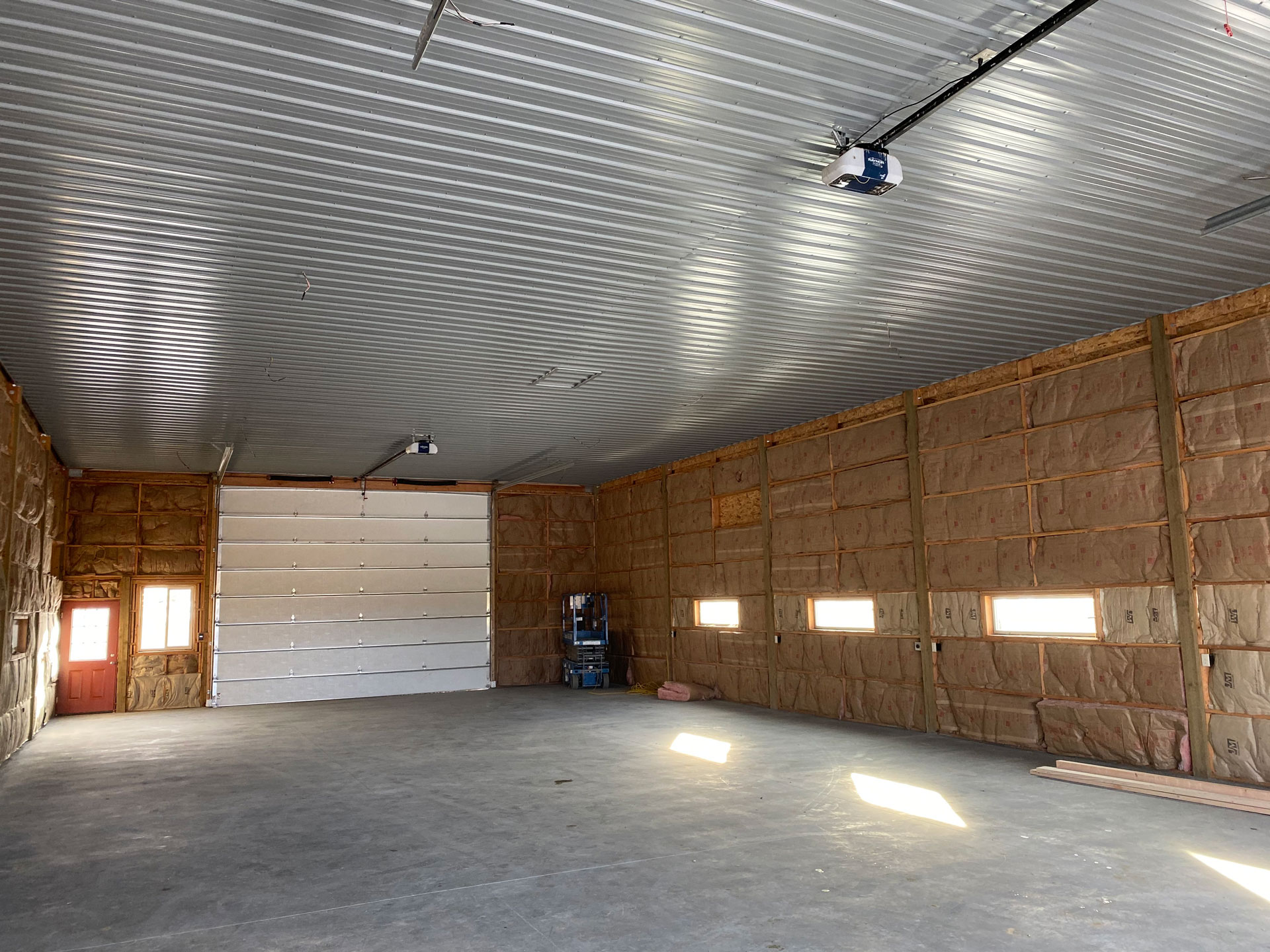
Depending on how you want to use your future building, you may want to consider insulating. No matter the climate in which your building is located, insulation will make it more comfortable in the warmer or cooler climates. A structure with properly insulated exterior walls and roof, has fewer drafts, holds its temperature better, and costs less to keep comfortable.
Generally, there are four different kinds of insulation; batt, blow-in, foam and Therma Guard.
Batt insulation generally comes rolled up in layers with varying thickness that you can cut to size and install with staple guns. Because it is usually made out of fiberglass fibers, it often punishes installers with itching and scratching.
The R-value and cost of batt insulation varies based on the thickness and type of density. The U.S. Department of Energy says a 3.5-inch fiberglass batt provides an R-value of 11 at a cost varying between 12 cents and 16 cents per square foot. That same batt in high-density form such as blown or foam delivers an R-value of 15 and costs between 34 cents and 40 cents per square foot. That is a lot of additional cost for a relatively small gain in insulation value. This is why batt insulation is cheaper in cost.
At the high-end of the R-value and cost spectrum is the 12-inch fiberglass batt. Is carries an R-value of 38 and costs between 35 cents and 60 cents per square foot. The thicker batt works great for insulating external walls and the rooftop.
Batt insulation has been around for many years and has insulating qualities that ensure it’s use for years to come.
Blown insulation is a more recent invention that simplifies that installation process. It is usually used in buildings or houses after the interior walls or ceiling is already finished. You simply cut a hole in an existing wall or ceiling and blow in the insulation. It is usually made with a combination of fiberglass and treated cellulose, similar to batt insulation but is much easier to install.
The blended insulation provides an R-value of around 32-38 per square foot. Loosely blown fiberglass alone carries an R-value of about 22-27 per square foot. The depth and thickness of the blown insulation affects the R-value as well as the blended amounts of fiberglass and cellulose.
Similar to blown insulation, spray foam is a new development in the industry.
One of the unique abilities of spray foam is getting into small cracks and crevices, unlike batt insulation which can leave a crack for air to get through. Once the foam is applied directly into the cracks, it expands and dries quickly while blocking air and water.
Even though the initial investment is bigger than other types of insulation, it actually saves you money on your bills in the long-term.
It’s also a good option for those who value privacy. The open cell spray foam insulation blocks noise better than any other type of insulation.
Therma Guard is a clean, non-toxic, easy to install, self-taping reflective foil insulation and vapor barrier that provides increased comfort, energy efficiency, and lower heating and cooling costs. It dramatically reduces heat gain and heat loss in your structure by reflecting the radiant energy.
Therma Guard effectively reflects a heat source as opposed to absorbing and dissipating it as fiberglass insulations do. This reflectivity works both ways: radiating summer heat outward and retaining winter heat inside.
Because Therma Guard is made with plies of foam (an extremely low-density, flexible polypropylene foam), it is much lighter weight and easier to handle than other reflective or fiberglass insulation products.
Therma Guard will provide equal or better insulation properties when compared to much thicker 2″-3″ fiberglass insulation, but will not produce an “oilcan” effect like thicker insulation can. Therma Guard is made with high quality reinforced aluminum foil film or a finished white reinforced polypropylene aluminum foil film. Choose the white-foil finish when a clean washable interior finish is needed and to give your structure a brighter look.
When installed correctly, Therma Guard provides an excellent thermal and vapor barrier, greatly reducing condensation build-up.
In addition, Therma Guard does not contain hazardous chemicals or materials that can cause itching or allergic reactions and all that is needed to install is a utility knife and staple gun. It does not require masks or long clothing for installation. To make installation fast and easy, every roll of Therma Guard has a patented self-taping flange running along one edge eliminating the need and the extra cost of seaming tape.
When properly applied, there is no reason each of these three types of insulation cannot last the lifetime of your home. Whichever you choose, all manufacturers say they will last a lifetime. For practical purposes, that means 100 years. Insulation only decomposes or loses its insulating quality if other factors impact it such as; exposed walls, flooding, and similar issues. So long as you maintain your structure properly, your insulation should last a lifetime.
The best way to ensure the longest life from either batt or blown-in insulation is to have them installed professionally. Although it often looks simple to most homeowners, it is easy to improperly install insulation and get reduced life and efficiency from the job. Careful preparation and using skilled and experienced labor can make the job last much longer.
Not sure what insulation is right for your building? Call Alpine Builders today! We are experienced builders and can help you plan your next project!